Call Us

Hello There!
Contact Us
-
-
Send Email
info@hfaurea.com
-
Location
No. 1788 Jinggang Rd, Shushan Qu, He Fei Shi, An Hui Sheng, China
Loading
Call Us
Send Email
Location
A 280Ah LFP prismatic cell built on in-situ solidification technology, delivering 896Wh per cell, 6000+ cycle life at ≥80% capacity, zero thermal runaway propagation at module level, and a wide operating range of −30°C to +60°C — available in ESS cabinet, container, and heavy-duty truck pack configurations.
 Zero Thermal Propagation
The semi-solid electrolyte (5–10% liquid content) fundamentally changes the thermal runaway behaviour of the cell. In module-level testing, a triggered cell reached 311°C and opened its safety valve, but adjacent cells remained below 82°C with no smoke, no fire, and only slight expansion — thermal runaway did not propagate. By contrast, a conventional liquid-electrolyte 280Ah cell in the same 1P52S module configuration caught fire and triggered full module thermal propagation under a 280A overcharge test. This is the defining safety advantage of semi-solid technology for stationary and mobile energy storage applications.
 6000+ Cycles ≥80%
The 280Ah semi-solid cell achieves a rated cycle life of 6000 cycles at ≥80% capacity retention under standard 0.5C charge / 0.5C discharge conditions at 25°C with 300±20kgf initial pressure. This translates to over 16 years of daily cycling at one cycle per day — significantly extending the economic life of the energy storage system compared to conventional LFP cells. The in-situ solidification technology stabilises the electrode-electrolyte interface, suppressing lithium dendrite growth and reducing capacity fade over the cell lifetime.
 −30°C to +60°C
The semi-solid cell supports discharge from −30°C to +60°C and charging from 0°C to +60°C, with a lower discharge voltage cutoff of 2.0V at temperatures ≤0°C (versus 2.5V at >0°C) to maintain usable capacity in cold climates. Short-term storage is rated to −40°C, making the cell suitable for outdoor ESS installations in extreme cold environments. The oxide-polymer composite electrolyte maintains ionic conductivity across this wide temperature range — a key advantage over conventional liquid electrolytes that freeze or decompose at temperature extremes.
 All Safety Tests Pass
The 280Ah semi-solid cell passes the full suite of cell-level abuse safety tests: overcharge to 25V, over-discharge to 0V, external short circuit at ambient and 150°C, 30% thickness extrusion, 5mm nail penetration, 1.2m drop, overheat to 160°C at 5°C/min, thermal shock from −40°C to +75°C (10 cycles), and direct heating thermal runaway test — all with no smoke, no fire, and no explosion. This comprehensive safety performance is enabled by the semi-solid electrolyte's inherently lower flammability and the in-situ solidification coating that passivates both cathode and anode surfaces.
LFP chemistry · In-situ solidification technology · 3.2V nominal · 896Wh per cell
| Parameter | Value |
|---|---|
| Electrical | |
| Nominal Capacity | 280 Ah |
| Nominal Energy | 896 Wh |
| Nominal Voltage | 3.2 V |
| Charging Upper Limit | 3.65 V |
| Discharge Lower Limit | 2.5 V (T > 0°C) / 2.0 V (T ≤ 0°C) |
| Standard Charging Power | 0.5P — 448 W |
| Standard Discharge Power | 0.5P — 448 W |
| Max. Discharge Power (1C) | 1P — 896 W |
| Cycle Life | ≥ 6000 cycles @ ≥80% (0.5C/0.5C, 25°C, 300±20 kgf) |
| Energy Density | |
| Gravimetric Energy Density | ≥ 165 Wh/kg |
| Volumetric Energy Density | ≥ 340 Wh/L |
| Internal Resistance | |
| AC IR (1 kHz, 25°C, 40% SOC) | ≤ 0.24 mΩ |
| DC IR (400A, 10s, 25°C, 25% SOC) | 0.5 ± 0.05 mΩ |
| Dimensions | |
| Width (mm) | 173.8 ± 1.0 |
| Thickness (mm) | 71.6 ± 1.0 (at 300 ± 20 kgf) |
| Height — Shoulder / Total (mm) | 204.0 ± 0.5 / 207.2 ± 0.5 |
| Pole Centre Distance (mm) | 123.0 ± 0.2 |
| Temperature & Storage | |
| Charge Temperature Range | 0°C to +60°C |
| Discharge Temperature Range | −30°C to +60°C |
| Short-Term Storage (1 month) | −40°C to +60°C |
| Long-Term Storage (6 months) | −10°C to +35°C |
| Storage Humidity | ≤ 95% RH, no condensation |
| Standard charge model: 0.5P CP to 3.65V → idle 30 min → 0.5P DP to 2.5V at 25±2°C | |
No smoke · No fire · No explosion across all electrical, mechanical, and thermal abuse tests
| Test | Condition | Pass Criterion | Result |
|---|---|---|---|
| Electrical Safety | |||
| Overcharge | 25°C, 0.5C charge to 25V or 1h | No smoke, no fire, no explosion | Pass |
| Over-discharge | 25°C, 1C discharge to 0V or 1h | No leak, no smoke, no fire, no explosion | Pass |
| Short Circuit | 25°C, <5mΩ wire SC to 0V or 1h | No smoke, no fire, no explosion | Pass |
| Short Circuit at High Temp. | Store at 150°C, <5mΩ wire SC to 0V or 1h | No smoke, no fire, no explosion | Pass |
| Mechanical Safety | |||
| Extrusion | Deform 30% on thickness direction | No leak, no smoke, no fire, no explosion | Pass |
| Nail Penetration | 5mm steel nail penetrate through | No leak, no smoke, no fire, no explosion | Pass |
| Drop | Drop from 1.2m, +/− terminals facing cement | No leak, no smoke, no fire, no explosion | Pass |
| Thermal Safety | |||
| Overheat | Raise to 160°C at 5°C/min, hold 1h | No smoke, no fire, no explosion | Pass |
| Thermal Shock | 10 cycles: −40°C ↔ +75°C | No leak, no smoke, no fire, no explosion | Pass |
| Thermal Runaway | Heating pad at max. capacity direct contact | Target cell: no fire, no explosion, no propagation | Pass |
| Module-level thermal runaway test (1P12S): triggered cell reached 311°C — adjacent cells remained below 82°C with no propagation | |||
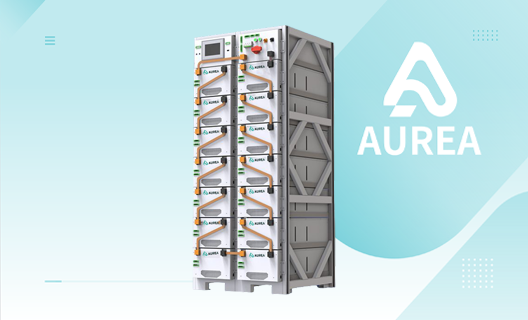
From cell to system — 1P12S / 1P13S modules, 43–46.6kWh standard packs, 215kWh ESS cabinets, and 3.35–5MWh container systems
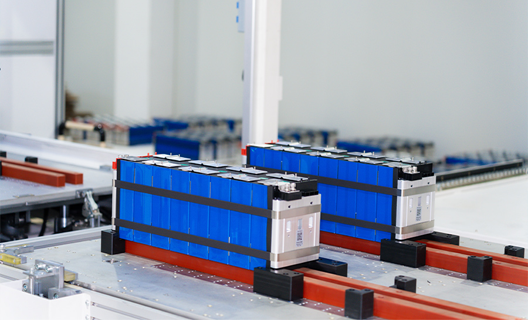
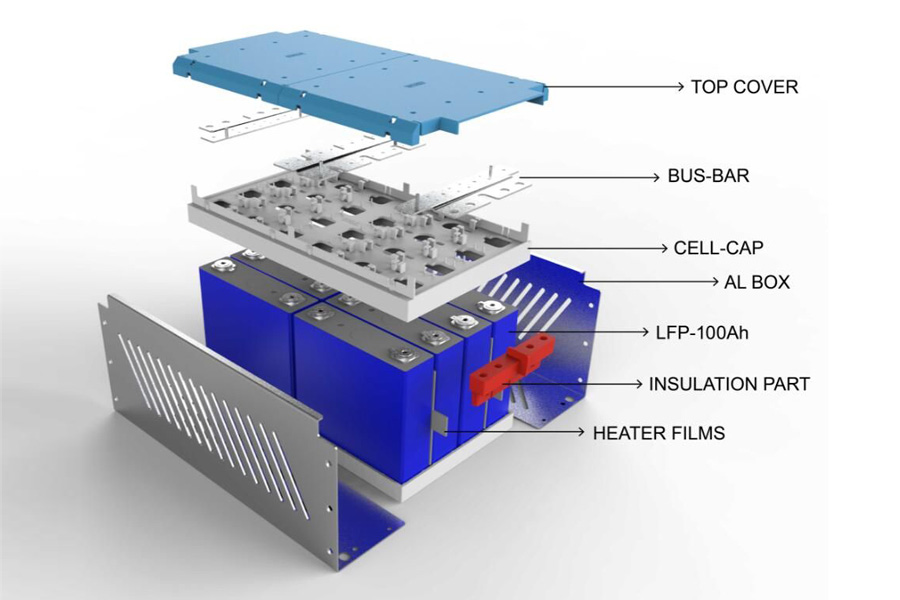
| Parameter | 1P12S Module | 1P13S Module |
|---|---|---|
| Cell | 280Ah LFP Prismatic | |
| Cell Quantity | 12 | 13 |
| Nominal Voltage (V) | 38.4 | 41.6 |
| Capacity (Ah) | 280 | |
| Nominal Energy (kWh) | 10.75 | 11.65 |
| Dimensions W×D×H (mm) | 910 × 175 × 215 | 982 × 175 × 215 |
| Energy Density (Wh/kg) | 153.2 | 153.6 |
| Gravimetric Efficiency | 94.1% | 94.5% |
| Welding Method | Laser welding | |
| Working Temperature | −30°C to +60°C | |
| Module Weight (kg) | 70.2 | 75.7 |
| No thermal propagation in 1P12S module TR test — adjacent cells below 82°C after trigger cell reached 311°C | ||
| Parameter | 1P48S Pack | 1P52S Pack |
|---|---|---|
| Cell Type | LFP Prismatic 280Ah | |
| Nominal Voltage (V) | 153.6 | 166.4 |
| Working Voltage Range (V) | 120–175.2 | 130–189.8 |
| Energy (kWh) | 43 | 46.59 |
| Energy Density (Wh/kg) | 140.5 | 141.3 |
| Dimensions W×D×H (mm) | 1069 × 787 × 235 | 1164 × 800 × 235 |
| Weight Est. (kg) | 309 | 329.5 |
| Cooling | Integrated liquid cooling | |
| Charge Temperature | 0°C to +60°C | |
| Discharge Temperature | −30°C to +60°C | |
| Storage Temperature | −10°C to +35°C | |
| Parameter | ESS Cabinet 215kWh | ESS Cabinet 232.9kWh | Container 3.35MWh | Container 5MWh |
|---|---|---|---|---|
| Cell Type | 280Ah / 3.2V | 280Ah / 3.2V | 314Ah / 3.2V | |
| Pack Configuration | 1P48S | 1P52S | 1P52S | 1P52S |
| System Configuration | — | 9 × 1P416S | 12 × 1P416S | |
| Energy | 215 kWh | 232.9 kWh | 3.35 MWh | 5 MWh |
| Nominal Voltage (V) | — | 1331.2 | ||
| Voltage Range (V) | — | 1123.2–1497.6 | ||
| AC Side Voltage | 380 Vac | — | ||
| Nominal Power | 0.5P | 0.5P | 0.25P | |
| Dimensions W×D×H (mm) | 1300 × 1200 × 2300 | 1300 × 1300 × 2300 | 20ft container | |
| Weight (T) | 2.35 | 2.6 | — | |
| Protection Class | IP55 | IP54 | ||
| Operating Temperature | −30°C to +55°C | |||
| Cooling | Liquid cooling | |||
| Fire Protection | Perfluoro + aerogel + water | — | ||
| Communication | Ethernet / Modbus TCP | — | ||
| Semi-solid chemistry · Safer and more reliable · Energy expandable · Easy to configure | ||||
Module-level test verified: triggered cell at 311°C — adjacent cells below 82°C, no fire, no propagation. Liquid electrolyte equivalent caught fire at module level.
≥80% capacity retention after 6000 cycles at 0.5C/0.5C, 25°C — over 16 years of daily cycling. In-situ solidification stabilises the electrode-electrolyte interface.
Discharge from −30°C, charge to +60°C, short-term storage to −40°C. Oxide-polymer composite electrolyte maintains conductivity across extreme temperature ranges.
Nail penetration, 30% extrusion, overcharge to 25V, 160°C overheat, thermal shock −40↔+75°C — all pass with no smoke, no fire, no explosion.
280Ah at 3.2V delivers 896Wh per cell with ≥165Wh/kg gravimetric and ≥340Wh/L volumetric energy density — higher than standard LFP prismatic cells.
Scalable from 10.75kWh modules to 215kWh ESS cabinets and 3.35–5MWh 20ft container systems — all with liquid cooling and IP54/55 protection.

Our engineering team is available Mon – Fri 8:00am – 6:00pm CST. Emergency support 24/7.